What most people call “translating” and “interpreting,” we like to call “language brokering.” When young people translate speech or text for their families, they are often doing much more than simple word-for-word movement between languages. This is because they are not just translating words; they are translating ideas. They are figuring out how to set the right tone for different audiences, how to paraphrase long ideas, how to funnel information in culturally appropriate ways, and more. Language brokers have to:
- Decipher and make sense of information about a wide range of subjects that are often expressed by speakers and writers in complex or unclear ways.
- Choose words that are appropriate for the genre, topic, and context.
- Choose appropriate ways of speaking that the audience can understand. (This includes dialect, word choices, tone of voice, and the degree of formal vs. informal speech, among other nuances.)
- Assume appropriate social roles – for example, as children speaking to and for adults in authority positions.
- Attend to the needs and expectations of multiple audiences – for example, a parent and a teacher.
- Convey information while juggling these competing social demands.
Here, we share two examples from research, where we explore the kinds of skills involved in youth language brokering.
Example 1: Excitement about Helping Out and Understanding Audience
Take a look at the following journal entry written by a 10-year-old girl who participated in our research in Chicago.
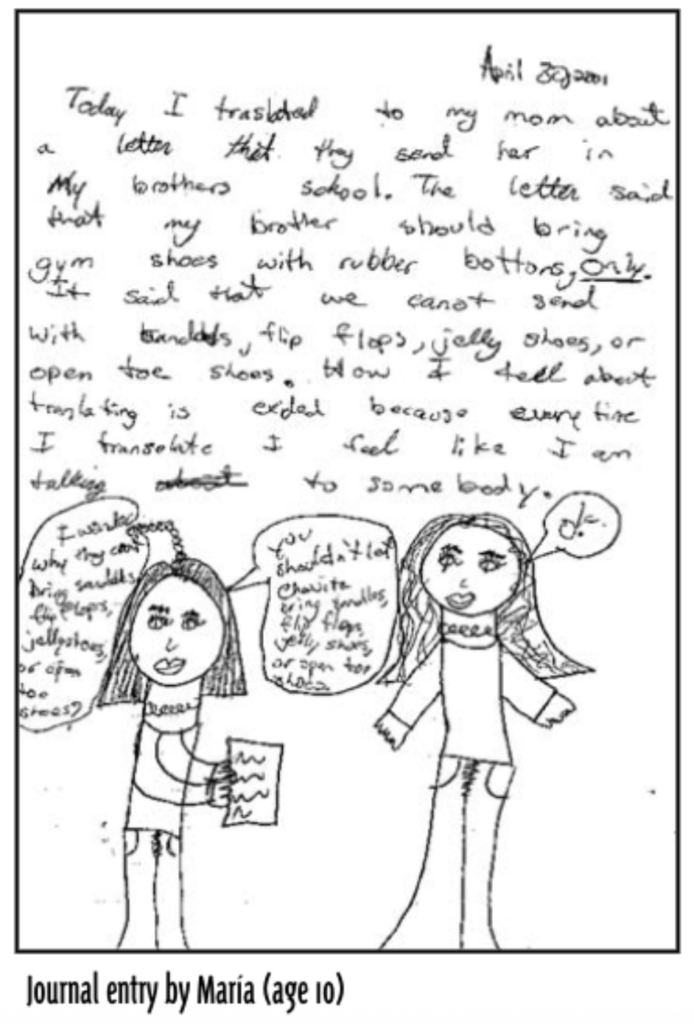
Here, Maria describes how she translated a notice sent from her school about the school dress code. The notice asked parents to send the right kinds of shoes to gym class; they should not be “flip flops,” “sandals,” “jelly shoes,” or “open-toed shoes.” Maria had to find the appropriate way to communicate these distinctions and how to emphasize certain ideas over others, like “rubber bottoms, only.” While we don’t know exactly how Maria did this based on this self-report, we do know how she felt about helping her mother in this way: she was excited, because for her, language brokering is an interpersonal experience. She gets to talk to her mother and even explain things to her. Maria draws herself dressed just like her mother, and almost the same height. She uses a speech bubble to report what she told her mother, and shows her mother accepting her words (“Ok”). María also uses thought bubbles to reveal her critical thinking skills: she is wondering why these rules exist.
We also want to draw your attention to the speech bubble that represents what she said to her mother: this is written in English, rather than the Spanish she uses regularly with her family. We think this represents her understanding of audience across different contexts. Here, she knows that the majority of the people on our research team speak English as their first language, so perhaps that is why she chose to use only English for this journal entry.
In short, this journal entry shows María as an active language user: someone who reads, writes, thinks about and reports on an everyday (but still rather complex) text. She uses her bilingual skills for home-school communication and enjoys the work!
Teachers might invite students to keep journals about times they have translated, to reflect on how they managed the situations, what choices they made, how they felt, and what made the work easier or harder. Perhaps students could get extra credit for reporting on this form of “home work” that they do every day!
Beyond Direct Translation: Paraphrasing and Using Gestures
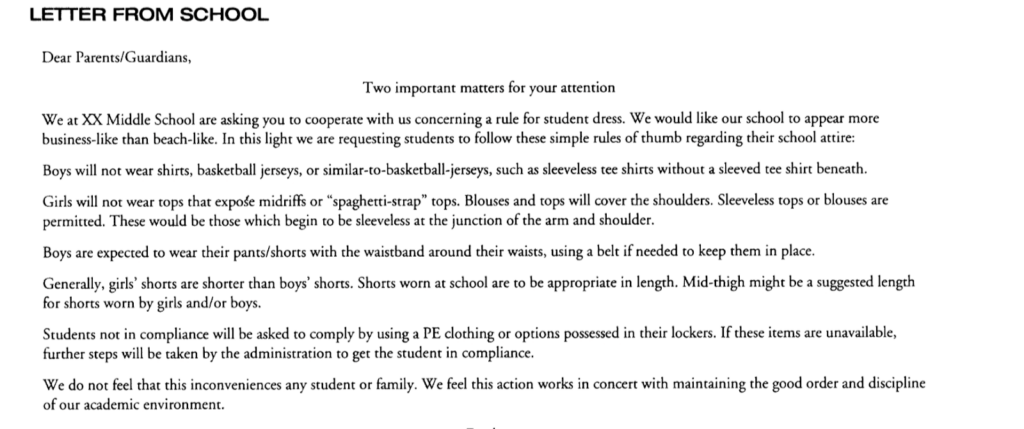
This example is from an article by Orellana, Reynolds, Dorner, & Meza (2003). Here, a middle school student, Miguel, with the help of his mom, translated the formal and rather stiff language of another school dress code letter:
Here is part of Miguel’s translation, speaking to his mom:
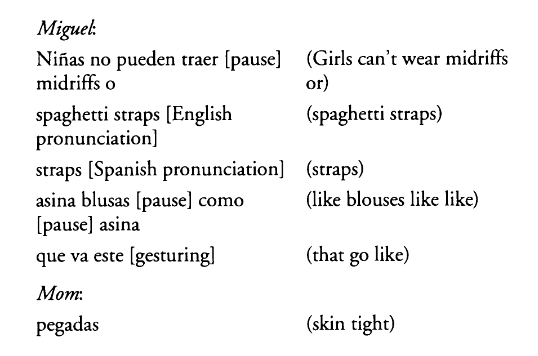
As part of our research, we recorded the conversation Miguel had with his mother about this letter. We noticed that he shared information in small bits and used gestures to explain to his mom about what he can and cannot wear to school. For words he didn’t know or couldn’t recall at the moment, he sometimes just read the English aloud, using either English or Spanish pronunciation. Other times, he paraphrased; that is, he explained the words using a variety of other ideas, rather than a direct translation, which is something many language learners and bilingual people do.
Too often we treat reading and comprehending texts as a strictly cognitive activity. But here, Miguel shows how reading is more than just an activity within his mind. He is using his knowledge of different languages, gestures, and movement to comprehend and communicate a text to his mother. Teachers might similarly invite students to use all their linguistic, cognitive, and communicative resources — including gestures — as they read and write in school.
Voice and Audience
Our third example is from a study by Martínez, Orellana, Pacheco, and Carbone (2008). In this project, we worked directly with students to consider how to build upon their language brokering skills.
When kids broker language, they have to shift their voices to address different audiences in appropriate ways. By helping them develop an awareness of their skills in shifting between different linguistic “codes” in language brokering situations, teachers can help apply these skills to their academic writing, helping them to think about how to make effective arguments and improving their persuasiveness.
After several lessons to help students see the skills they use in language brokering, students were asked to write a persuasive essay for two different audiences of their choosing. One was a more “formal” and distant audience (their principal, the superintendent, the governor); the other was for someone they know well (their mother, a friend).
Can you guess which excerpt below is for which audience? See how Christina used a different tone and different word choices for each essay. She even shifts between different rhetorical techniques, such as inviting her friend to agree with her (“Don’t you think…”) in an impassioned way, while speaking in the third person to the principal.


When kids broker between languages, they grow their skills in interpersonal communication, their awareness of power dynamics and identities, and their own sense of what it means to be multilingual.