We are a team of researchers, teachers, and language brokers from the University of California-Los Angeles and the University of Missouri-Columbia. We have worked with public school teachers and students in a variety of geographic and sociocultural contexts — from Chicago to Los Angeles, from Mexico to Nebraska, from Missouri to Japan. We share an abiding interest in the work of language brokers and the rich and complex skills they build when they read, write, and speak for (and with!) their families and friends across languages and cultures. Our most recent collaborations have included bringing together teachers from across the United States to think about how to leverage language brokering in the classroom. We also developed a storytelling contest, which resulted in these amazing essays, in 2026 to showcase the diversity of language brokering, and we continue to bring together a variety of perspectives on language brokering in conference symposia, on this website, and in a planned edited volume.
Our team represents scholars on language brokering and bilingual education policy who have worked in the field for decades, as well as younger teachers and language brokers who are now building their own scholarly careers.
Some of Our Bios
Marjorie Elaine (formerly Marjorie Faulstich Orellana) is Professor in the School of Education and Information Studies at UCLA. She was the Associate Vice Provost of the International Institute from 2022-2025 and the Associate Director of the Center for the Study of International Migration from 2015 through 2021. Her research centers on the experiences of immigrant youth in urban schools and communities, especially as language and cultural brokers for their families. She is the author of Translating Childhoods: Immigrant Youth and Cultures (Rutgers University Press, 2009), Immigrant Children in Transcultural Spaces: Language, Learning and Love (Routledge, 2016), Mindful Ethnography: Mind, Heart, and Activity for Transformative Social Research (Routledge, 2019), and two co-edited volumes: University Community Partnerships for Transformative Education: Sowing Seeds of Resistance and Renewal (Springer, 2024; available Open Access), and Language and Cultural Processes in Communities and Schools: Bridging Learning for Students from Non-Dominant Groups (Routledge, 2019). She was selected as a Fellow of the American Educational Research Association in 2021 and is a past president of the Council of Anthropology and Education. She was a bilingual classroom teacher in Los Angeles from 1983 to 1993. Her Substack column can be found here.
Lisa M. Dorner is a Professor in the Department of Educational Leadership and Policy Analysis and Director of the Cambio Center at the University of Missouri-Columbia. She is a teacher, researcher, and life-long learner, a lover of language, intercultural connection, and the idea of educación. Striving to work alongside communities to disrupt inequities, her research work falls into three main areas: the politics and planning of bilingual education, educational policy enactment, and immigrant childhoods, especially as related to family-school engagement and language brokering. As Cambio Center Director since 2022, Lisa has developed new connections throughout Missouri and integrated a storytelling festival into the annual “Cambio de Colores” conference, the center’s core outreach effort designed to develop a community of practice among researchers and practitioners focused on building bridges and creating strong, integrated, caring communities. She has co-edited two books geared toward immigrant education: Critical Consciousness in Dual Language Bilingual Education (2022) and Educational Leadership for Immigrants (2019). Lisa was lucky to be Marjorie’s first graduate student, who worked on her first research team in Chicago focused on language brokering. Read more at lisamdorner.com.
Jackson Gzehoviak is a Ph.D. candidate in Education at the School of Education and Information Studies at UCLA (as of fall 2026). They received their Bachelor’s Degree from Harvard College and their teaching credential at the Harvard Graduate School of Education. They taught high school social studies and English as a Second Language from 2016 to 2022. Jackson has served as the Education Director for Learning for the Empowerment and Advancement of Palestinians (LEAP), an English language and socioemotional learning program for Palestine refugee youth in the refugee camps of Lebanon. Currently, their work focuses on the dynamics of language choice, language reclamation, and comparative frames of indigeneity among Indigenous Latinx youth from Guatemala who are newly arrived to Southern California. Their other work, broadly, engages community engaged and community-based research that examines the relationships between immigration, family dynamics, and racialization, and the role of language ideologies as a relational mediator.
Sarah Pérez is a doctoral student in Education at the School of Education and Information Studies at UCLA (as of fall 2026). Her work explores learning shaped by and unfolding through relationships, place, and belonging among immigrant youth and communities. Currently, she is examining how immigrant youth and communities draw on memory, place, and relationships to care for one another and imagine their futures. Prior to graduate school, she was a youth worker in Los Angeles, supporting first-generation college access and engaging students, schools, and families. She grew up as a child language broker for her family and community, an experience that continues to shape how she approaches and does scholarship. For this volume, she is co-editing and contributing a chapter on her own experience as a language broker.
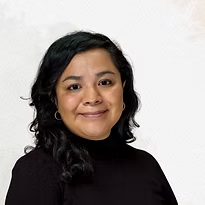
Dr. Krissia Plascencia holds a Ph.D from the UCLA Graduate School of Education in Urban Schooling and a B.A. from UC Santa Cruz in Latin American and Latina/o/x Studies and Legal Studies. Her research examines educational and health inequities through the experiences of children and young people who translate and explain culture for health-related needs. She has been published in the Journal of Leadership, Equity, and Research, International Migration, and Talking Points. She is currently a lecturer for the Mexican American and Latino Studies Department at UT Austin, and the Senior Academic Program Coordinator for the Latino Research Institute. In her current roles, she mentors, teaches, facilitates trainings and knowledge-sharing initiatives, establishes and grows partnerships, and manages multiple research assistants, programs, and projects.